
Tskhinvali counts war trophies
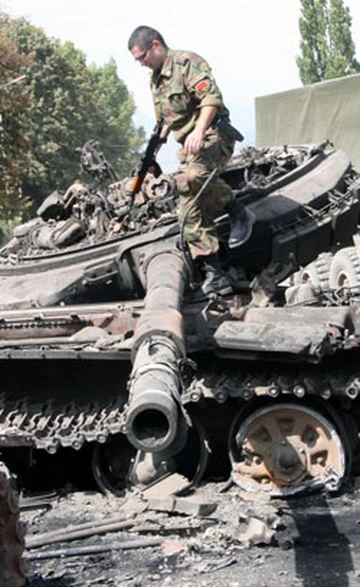
It's the scrapyard for this destroyed Georgian tank.
Читайте: В Цхинвали считают трофейное оружие
South Ossetia's capital Tskhinvali is regaining consciousness after the 5-day war. There is still no water, electricity or food. Shooting can be heard in the evenings on the outskirts of the city and the odor of death still lingers as many bodies lie deep beneath the rubble.
Finally, a unit of Russia's Special Construction Division arrives. Their first task is to rebuild two Tskhinvali schools before Sept. 1. Then they will begin constructing an electric energy plant and a hotel.
The Russian army is busy gathering war trophies. Numerous tanks have been commandeered and are now parked at an automobile yard in Tskhinvali. Polish self-propelled artillery and a Turkish armed car carry the highest price among the spoils. The soldiers say the car was halted using an armor-piercing bullet that was fired from a high caliber weapon.
"It's a catafalque, not an armed car," a young lieutenant told KP after inspecting the vehicle and jotting down the details in his notebook. "We'll check all the tanks and then enter them into our inventory. They'll serve Russia from here on in."
All in all, the Russian military commandeered over 60 tanks and armored personal carriers — mainly Soviet-era equipment that has undergone modernization in Ukraine and the Czech Republic. All the technology is in working order.
Stalin's hometown
It turns out the road is now open from South Ossetia to Stalin's hometown, Gori. Today, the city looks like Pripyat near Chernobyl. There is no one on the streets. Only 1,000 of Gori's 60,000 residents remain. Most are elderly. Some men are hiding in the courtyards drinking wine. The Georgian authorities were the first to leave the city, leaving their people behind in the chaos. In recent days, the Russian army has brought 24 tons of humanitarian aid to the city and chased away all the looters.
A partly lowered Georgian flag still flies above the city council, although the city's status remains questionable. The South Ossetians say Georgia took Gori after the 1992 conflict. Today, the area is full of peacekeepers.
The shooting has now ceased in Tskhinvali. Before the 5-day war, the Georgians accused the South Ossetians of shooting first. "We were only firing back at the attackers," they said. But the quiet in Tskhinvali is a clear sign of who began the shooting after all.
Older Georgians sit on a bench near the water fountain. I look at the cold running water differently from many Gori residents. Tskhinvali and Gori have the same plumbing system, but the South Ossetians haven't had water for a long time. I tried to speak with them to see if they knew who was to blame for the bloody war. Their opinions differed.
"The youth and Saakashvili started the war," they said. "We don't need any war. We've been living in peace with the Russians for years," and "The Russian army is feeding us. Where are the Georgian authorities?"
I left as soon as the heated political arguments began.
Who bombed who?
The international humanitarian organization Human Rights Watch announced that Russia used cluster bombs while fighting in Gori. A middle-aged Georgian man called me into the courtyard of a 5-story building.
"Come on, I'll show you a cluster bomb," he said. "They dropped them on us."
As I approached, I saw that the building had indeed been hit by a wave of shrapnel. But I had seen similar damage in areas near Gori that were the result of Russian planes bombing Georgian artillery yards. He showed me a huge iron cylinder. Then he opened the doors to his garage and pointed to several aluminum parts lying on the floor inside.
"There it is! A cluster bomb!" he said.
"Show me where the bomb fell," I said. "Show me the crater..." But there were no craters. Not a single one.
He started to get irritated. I guess the Western journalists in Gori believed him without asking any questions.
Everything is more than clear to me. Already a week ago, I heard about the mythical bombings of Gori.
Even then, no one could show me where a single bomb had fallen. It seems no one in Gori or Georgia has yet been able to comprehend who started this war. Everyone is too busy dealing with their own problems to think clearly.
Nevertheless, I think it's safe to say no one wants a repeat to the 5-day war.
KP Dossier
Russia's war trophies:
44 Т-72 Soviet tanks previously modernized in Ukraine;
15 BMP-2s;
5 anti-aircraft weapons "Osa";
6 armored carriers "Cobra" (НАТО);
2 artillery systems "Dana" (Czech Republic);
16 boats;
764 М-16s (U.S.);
28 М-40s (U.S.);
754 AK-47s.
Читайте: В Цхинвали считают трофейное оружие
